For the first time in modern history, India stands at the threshold of becoming a global manufacturing powerhouse for electronics and IoT hardware. The numbers tell a compelling story: electronics production has surged from ₹1.90 lakh crore in FY2014–15 to ₹9.52 lakh crore in FY2024–25, a compound annual growth rate of over 17%. Exports have grown even faster, rising from ₹0.38 lakh crore to ₹2.41 lakh crore over the same period, reflecting a CAGR exceeding 20%.
But for C-suite decision-makers evaluating where to place their hardware bets, the question is no longer whether India can manufacture. The question is: Can India design, innovate, and export high-value IoT products that command premium margins in global markets?
The answer lies in understanding the evolving landscape of India’s Production-Linked Incentive (PLI) schemes and, more importantly, in choosing the right strategic partner to navigate this opportunity.
The PLI Evolution: From Import Substitution to Export-Led Growth When the PLI scheme was launched in April 2020, its primary objective was clear: reduce India’s dependence on imported electronics by incentivizing domestic production. The results have been remarkable across multiple sectors :
Electronics exports grew at 38.8% average annual growth rate (AAGR) between FY21 and FY25 IT hardware exports surged at an astonishing 77.2% AAGR over the same period Telecom equipment exports rose while imports declined by 18.5%, demonstrating successful import substitution The government allocated approximately ₹2.9 lakh crore for PLIs across 20 sectors, generating over five times the scheme’s cost in extra output and creating nearly 12 lakh jobs.
But here is the critical insight for senior executives: the first phase of PLI has largely achieved its goal of domestic market self-sufficiency. Today, virtually all smartphones sold in India are assembled locally. The policy focus is now shifting decisively toward export-led growth and higher domestic value addition.
The New PLI Paradigm: What It Means for IoT Hardware The next generation of PLI incentives, currently being finalized for sectors including electronics components, wearables, and IoT devices, represents a fundamental strategic shift :
1. Export-Linked Incentives Under the new framework, government subsidies will be directly tied to export volumes, not just domestic production. For the first time, manufacturers who successfully penetrate global markets will receive preferential support.
2. Local Value Addition Requirements Incentives will be tiered based on the percentage of locally sourced components, from basic assembly to high-value sub-assemblies like display modules, camera modules, and PCBs. The message is clear: the government wants India to move beyond “screwdriver assembly” to genuine manufacturing.
3. Capital Expenditure Support The newly approved ₹22,919 crore Electronics Component Manufacturing Scheme offers up to 25% capex incentives for investments in advanced manufacturing infrastructure. This is designed to bridge the gap between India’s current capabilities and global competitiveness.
4. Employment-Linked Benefits Unlike earlier iterations, the new schemes offer additional incentives for meeting employment generation criteria, recognizing that manufacturing’s true value lies in job creation.
The Global Opportunity: India’s Moment in IoT Exports India’s emergence as the world’s second-largest mobile phone manufacturer, with over 300 manufacturing facilities compared to just 2 in 2014, demonstrates what is possible when policy and execution align. In 2025, India surpassed China to become the largest source of U.S. smartphone imports.
For IoT hardware specifically, the opportunity is even more compelling. The global IoT market is projected to reach trillions of dollars in value over the next decade. India is uniquely positioned to capture a significant share, with:
A proven electronics manufacturing ecosystem that has scaled from mobile phones to wearables, routers, and smart home devices Deepening capabilities in component manufacturing, including multi-layer PCBs, passive components, and display modules A young, technically skilled workforce that can support both design and manufacturing functions Government commitment to semiconductor and electronics self-reliance The Strategic Challenge: Design Capability Remains the Bottleneck Despite these tailwinds, one critical gap persists: design capability. India has built world-class assembly and manufacturing capacity, but the higher-value activities, system architecture, silicon integration, RF design, certification strategy, and full product development, remain concentrated in China, Taiwan, and Vietnam.
This is where the strategic calculus for Indian executives becomes crucial.
You can certainly export “assembled in India” products with imported designs. But the margin structure of such products is fundamentally constrained. The real value, and the real PLI benefits, accrue to those who design in India, achieving higher local value addition and creating defensible intellectual property.
The Co-Design Alternative: Speed with Sovereignty At Cionlabs, we have developed a partnership model that addresses this gap directly. Our strategic co-design approach enables Indian brands to export IoT hardware that is genuinely “Made in India”, not just assembled here, but conceived, architected, and optimized for global markets from Indian design centers.
Consider our recent partnership with a leading Indian consumer electronics brand (detailed in our case study). They faced a choice:
Option A: Import a generic white-label design, launch quickly, but compete on price with zero differentiation Option B: Build in-house from scratch, control the IP, but face an 18-month development timeline We offered a third path: strategic co-design. By partnering with Cionlabs and leveraging our deep expertise with Beken’s advanced Wi-Fi chipsets, they launched a custom-designed smart home hub in just 11 months, a 40% reduction in time-to-market, while retaining full IP ownership and Bill of Materials (BOM) control.
The result was not just a faster launch. It was a superior product, with 30% better range in dense urban environments than competing devices, and a platform for an entire ecosystem of future products, all built on their own IP.
The PLI-Export Connection: Why Design Partners Matter For senior executives evaluating export strategies under the new PLI framework, the choice of design partner has become a strategic variable with direct financial implications:
DimensionWhite-Label ImportIn-House DevelopmentStrategic Co-Design (Cionlabs)PLI EligibilityLimited (low value addition)FullFullExport IncentivesMinimal (design not Indian)MaximumMaximumTime-to-MarketFast (3-6 months)Slow (12-24 months)Accelerated (6-12 months)IP OwnershipNoneFullFullBOM ControlNoneFullFullDifferentiationCommodityUniqueUniqueRisk ProfileLow upfront, high long-termHigh upfrontManaged The new PLI paradigm rewards local value addition, and local value addition in IoT hardware comes primarily from design, not assembly. A product designed in India, using locally optimized BOMs and incorporating Indian-developed firmware and algorithms, qualifies for the highest tier of incentives, both for domestic production and for export.
The Cionlabs Advantage: Building Export-Ready IoT Hardware Our partnership with Beken, a pioneer in wireless chipsets, gives us unique capabilities that are essential for export-oriented IoT products:
1. Silicon-Level Optimization Beken’s chipsets, including the BK7236 with its industry-leading low-power Wi-Fi 6 (13mW receiver功耗) and the BK7239 with dual-band Wi-Fi 6, enable products that meet the stringent performance requirements of global markets. Our deep integration with Beken allows us to optimize RF performance, power consumption, and cost structure in ways impossible with generic modules.
2. Compliance-Ready Design Global markets demand rigorous certifications: FCC for the U.S., CE for Europe, and increasingly sophisticated cybersecurity standards. Our design process incorporates compliance requirements from day one, not as an afterthought. This is particularly critical for export, where certification delays can derail entire product launches.
3. India-Validated, Global-Ready The same design choices that make products robust for India’s challenging operating conditions, high temperatures, voltage fluctuations, dense RF environments, also make them reliable for global markets. Our “Stress Kitchen” validation methodology, which tests products against real-world Indian conditions, produces hardware that consistently outperforms competitors in standardized global benchmarks.
4. Export-Ready Supply Chain We don’t just design products; we prepare them for volume manufacturing with supply chains that meet global cost and quality standards. Our vendor networks, component sourcing strategies, and manufacturing partnerships are optimized for scalability.
A Framework for Export Strategy Decision-Makers If you are evaluating whether to invest in India-designed IoT hardware for export markets, consider these strategic questions:
1. What is your value proposition in global markets? If you are competing on price alone, a white-label import strategy may suffice, but the margins will be thin and the competitive advantage short-lived. If you are competing on features, performance, or brand experience, custom design is essential.
2. How critical is IP ownership to your long-term strategy? Products designed in-house or through co-design partnerships create IP assets that can be leveraged across product lines and geographies. White-label imports leave you with no proprietary technology and no barrier to entry for competitors.
3. What is your tolerance for timeline risk? In-house development is unpredictable. Strategic co-design with an experienced partner reduces timeline risk while preserving strategic control.
4. Are you positioned to capture PLI benefits? The new PLI frameworks reward local design. If you are assembling imported designs, you are leaving significant incentives on the table, and missing the opportunity to build a genuinely Indian manufacturing business.
The Path Forward: Building India’s IoT Export Industry India’s electronics manufacturing journey over the past decade has been extraordinary. The next decade will be about moving up the value chain, from assembly to design, from import substitution to global leadership, from “Made in India” to “Designed in India for the World.”
At Cionlabs, we are committed to being the design partner that enables this transition. Our model is simple: we combine deep technical expertise, particularly in Beken-powered connectivity solutions, with a partnership approach that respects your IP, accelerates your timeline, and prepares your products for global markets.
The pieces are in place: a supportive policy framework, a proven manufacturing base, and a rapidly growing global demand for IoT products. What’s needed now is the design capability to turn these advantages into globally competitive products.
Are you ready to build your export-ready IoT hardware from India? Let’s talk.
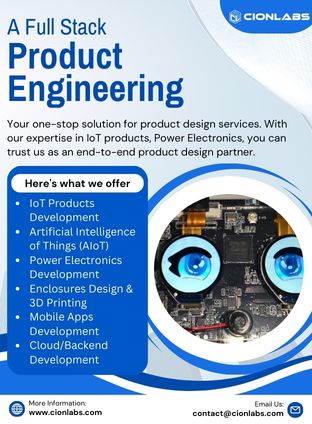
Cionlabs is an electronics design house specializing in IoT solutions for the Indian market. Cionlabs partners with Beken, a pioneer in wireless chipsets, to deliver white-label products and custom designs for smart home, robotics, AI cameras, and industrial IoT applications. With deep expertise in export-oriented product development and India’s PLI framework, Cionlabs helps brands transform their IoT ambitions into a globally competitive reality.